Thursday, July 28, 2011

All Herefords Great and Small


Following the past season's A & P Shows and an article in a magazine about my Miniature Herefords there has been a steady flow of interest from all walks of life.   Contacts have been made via e-mail, telephone or directly and several have then visited our farm to get a close-up view of the small cattle.   As we also have a conventional Polled Hereford Stud this adds to the enjoyment as there is an obvious comparison of sizes to view.

 With our big Herefords we have what we call a more "traditional" sized herd, the average size being slightly smaller than most which particularly suits our dairy farming clientele.   Among these animals are a few which in America would be classed as "Classics" with Frame Scores of 3 and a couple may well be only FS 2 when mature.   A comment often made about the minis is "They look just like the big Herefords."   Of course they do.   A Miniature Hereford should simply be a small replica of the larger animal but they're all full blood Herefords no matter what their size and, in the case of our herds, pedigreed, registered cattle.

Miniature Herefords are classified by a measurement across the backbone at the hips converted into Frame Score.   The breeding programme to produce miniature sized Herefords was started in the USA in the 1970s and the generally accepted size for these small cattle on reaching maturity at three years of age is 114.30 cm (45 inches) for cows and 121.92 cm (48 inches) for bulls.   That upper limit is known as a Frame Score of 1 but the miniatures can go well down the scale, some having been recorded as FS 0000 - 93.98 cm (37 inches) for cows and 101.60 cm (40 inches) for bulls.   Above the upper height for FS 1 they are classed as "Classics" in the States but on reaching 129.54 cm (51 inches) or more they become known as the Modern, Standard, Regular or Conventional Hereford with frame scores between 4 and 10, the last being extremely tall.   New Zealand does allow slightly larger sized cattle to be classed as miniature but, however great or small, they are all Herefords, not different breeds.   It is only their size which distinguishes the varieties of the one breed.

Both the move toward larger Herefords and smaller Herefords began around the same time.   Eventually it was apparent the really big animals were not coping as well with adverse conditions so overseas there has been a turnaround to downsize them a bit.   The Miniature Herefords have their own problem when becoming too small as there is no longer any meat value and some of them begin to look quite stunted, losing the conformation of the bigger animals.   For me, the ideal size of a Miniature Hereford is between a Frame Score of 00 and 1.   This is where there is the potential of being able to produce a compact, meaty animal, easily managed and less damaging to pasture and facilities.

A problem facing any variety of a breed which is in small numbers is that without a steady source of new bloodlines breeders are restricted to a limited gene pool.   Miniature Herefords face this in that they are a relatively new variety of the Hereford breed stemming from a small selection of foundation animals.   Originally bred by using the smallest regular sized Herefords available then progressively downsizing to what is now recognised as miniature size the herds now rely on introducing new bloodlines by occasionally going back to larger varieties - usually the Classic sizes - then continuing to downsize the progeny.   This is not crossbreeding - it is simply utilising different sizes to achieve the desired end result of miniature size.   All the animals used in such a programme are full blood Herefords and should be registerable as such.


Up to now Miniature Herefords in New Zealand have all been horned although for many breeders the polled variety is preferable.    Owing to the very slow processes involved in importing polled Miniature Herefords New Zealand breeders have to look at how their counterparts in the States and Australia developed their herds and follow suit.    At this stage it basically means using a horned miniature bull over polled standard Hereford heifers which have been selected for their small size and lack of any horns or scurs in their backgrounds.   Unless suitable polled mini bulls can be acquired this is a long term breeding programme over many years but the results are worth it.   All the progeny, regardless of how much miniature or regular genetics they have, are still Herefords with the trademark features.    


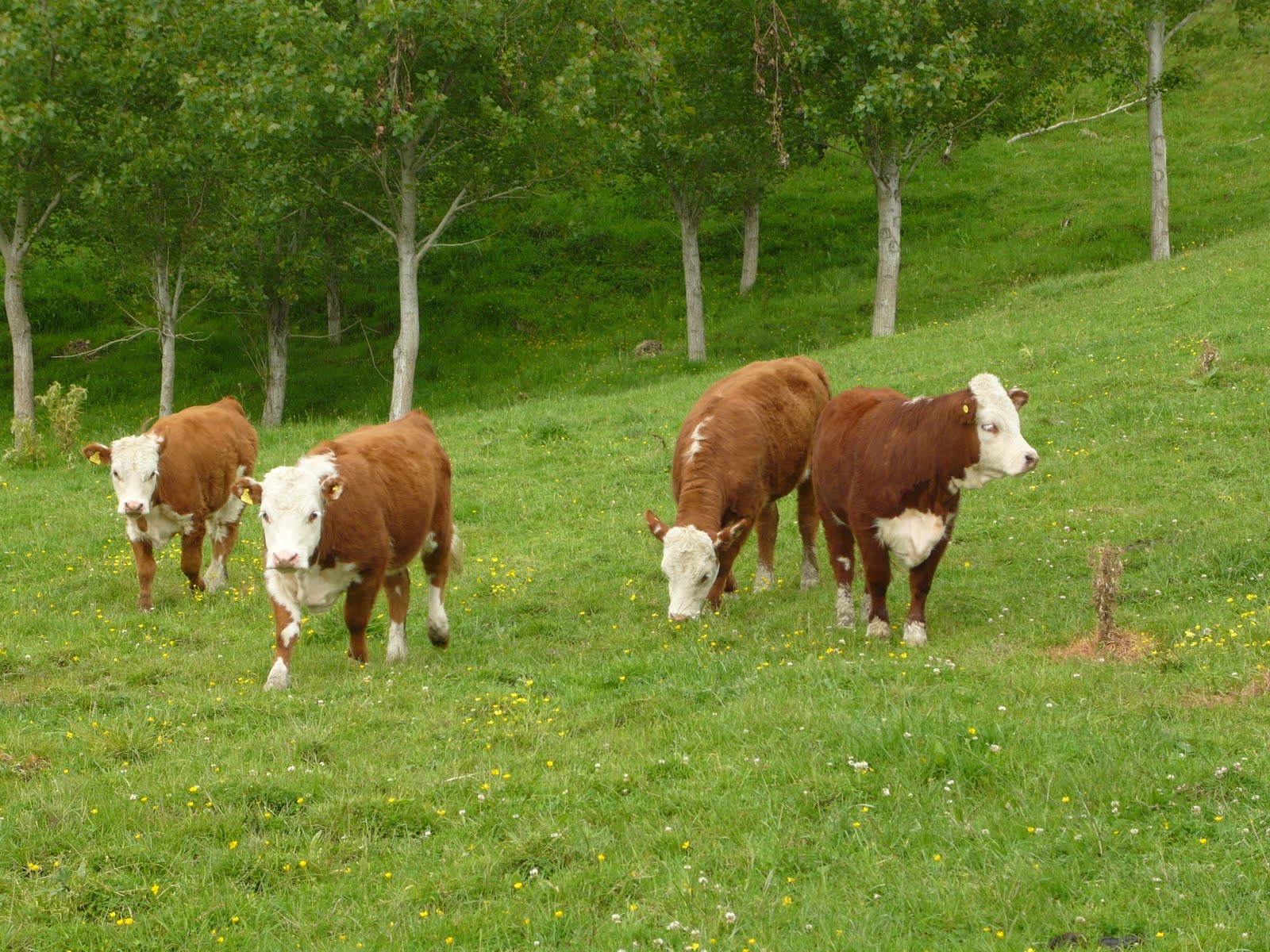
The category of "miniature" can be applied once progeny reach a particular size - this can be sooner or later depending on the type of Herefords (big and small) used.   Once that size has been reached then it is a matter of selecting bulls and cows with similar sizes in their ancestry and progressing from there.   Whether they have other varieties of Hereford in their pedigree is irrelevant, unless breeding for the polled factor, as they have all contributed to the eventual miniature size.    The photos in this story are a mixture of regular, Miniature and regular/miniature Herefords.   Great and small, they are the one Hereford breed.


Saturday, July 2, 2011

A Mini Mynah

It flew a curving line up into the clear cold sky.   Without a backward glance.   As free as the bird it is - gone, gone, GONE!   So much for all my nurturing over the previous months.

Earlier in the year my daughter had come running down from the hayshed calling out that there were some baby birds lying injured on the ground.   Ever a sucker for animals in distress I went to investigate.   Three wee blind, featherless chicks of indeterminate breed.   One was dead, one had a twisted leg and the other had crawled several metres out by the driveway.   Back to the house they came and were put into a small box lined with soft cloth and hay.


 Looking at their beaks I realised they were probably meat eaters so mashed up some cat meat with gravy and starting feeding them every half hour.   At night they were put in the hot water cupboard.   In the morning the chirping began as soon as they saw light.   This went on for just over a week before the weaker one with the bad leg died - fortunately perhaps as I didn't think I could mend it.   But as for the other - it thrived.   A tiny bit of Farex was added to its diet then crushed cat biscuits softened with water.   It thrived.   The eyes opened, down appeared on its little body and it would nestle quietly in my hand while feeding.   It thrived.   Feeding times became more spaced out and a bigger box was needed to allow it more room for its gangling legs.   By now it was obvious it was a mynah.


Time passed, the bird grew and real feathers started to appear.   Now it wanted to flap them so it was moved to a large bird cage during the day.   This was put in a spare bedroom so that it could experiment with its wings outside the cage.   As it became more mobile a couple of branches were put in the cage to encourage it to perch.   It began to perch on my hand, then my shoulder and with the full development of its wing and tail feathers it would flutter short distances around the room.The cage was moved back to the garage and came the day that it jumped out and flapped its way clumsily to one of the rafters.   This became a daily exercise for it.   It also delighted in splashing around in a sink of shallow water.

Finally it was time to let my fully feathered friend discover the great outdoors.   By now it would keep flying back to me so I was confident this would continue outside.   Maybe it could help me in the garden by cleaning up all those lovely bugs.   Taking a big breath and with bird on my shoulder I opened the side door to the garage.   A rush of air as it took off and within seconds it had disappeared from sight!   For two days the little bird was nowhere to be seen or heard and I just hoped it had not met with some horrible fate in the form of a hawk, wild cat or even the magpies which frequent the garden.  Then one morning I saw a Mynah fly into a tree up behind our house.   I called it and although it did not respond nor did it fly away.   The next morning the same thing happened but this time I whistled and the bird came down to a tree near me.  


With a bit more cajoling in the form of whistles and talking quietly it eventually alighted on my shoulder.   No mistake.   This was my bird!   Since then, the Mynah has made its home in the garage which it can fly into or out of as it likes.   Although it can fend for itself there is a small dish in the garage which has a daily piece of dog roll meat, some fish-flavoured chook pellets and cat biscuits softened with a bit of water - just as a top up.   Known as Dickeybird or The Vandal, depending on what it is doing the Mynah's curious nature is evident in the way it likes to "get involved" with whatever we are doing.   Nuts and screws get picked up and dropped further away in the workshop, pieces of paper are snatched off a bench and anything hanging loose is fair game.   Visitors are warned that they may find a small passenger suddenly perched on their shoulder or head.  


The bird also likes exploring the various vehicles on the farm..........


and trying to come into the house.


We find ourselves going through a range of emotions with this small addition to the "family" from entertainment to frustration depending on its antics.   Would I do it again - raise an orphan?   Of course.


As they say - a bird in/on/near the hand is worth two/three/or more in the bush.

Monday, June 27, 2011

Know Your Genes

For everyone interested in genetics Southern Beef Technology Services in Australia is running a series of Webinars over six weeks which are free to take part in.   These started on Monday, June 20th, 2011 - New Zealand time 10 pm.

Topics being covered are:

1. DNA Technology - Understanding the Basics
2. Utilising DNA for Parentage Verification
3. Managing Genetic Conditions with DNA
4. Utilising DNA to Change Type Traits
5. Improving Production Traits with DNA
6. Assessing the Cost-Benefit of DNA Technology

The fourth webinar should be of particular interest and use to anyone wanting to breed polled Miniature Herefords.

You can register by going to http://sbts.une.edu.au/ and clicking onto the Webinar section.

Having already taken part in previous webinars I can recommend these as being well worth attending.

Sunday, June 26, 2011

Results of First Virtual Cattle Show For Miniature Herefords - June 2011

With eleven competitors from Australia, the United States and New Zealand and a total of sixty-three entries across the twelve classes this has been a small but successful start to a new type of showing.   There has been enough positive feed back to warrant holding it again next year and it seems the month of June is probably the best time but this will be confirmed.   The programme will be much the same but with a few adjustments to bring it in line with more serious competitions.   There will also be an effort to find sponsors from each of the competing countries who could supply real prizes to the place getters.
A common comment was the appreciation of being able to view Miniature Herefords of similar ages in the different countries.   This gives current and aspiring breeders new ideas for developing and improving their own breeding programmes.   A sharing of experiences is always helpful.
Results of the twelve classes are:
Class 1 -  Senior Cow 3 yrs and over with calf/calves at foot


             2nd - SS Miss Elizabeth and calf.


1st AMH Babette and calf.
                                                                                                                                                                                                                                                                             
3rd - Grovenorth Abby and calf

1st - AMH Babette and calf.   Julie Stott, New South Wales, Australia.
2nd – SS Miss Elizabeth and calf.  Charlotte and Steve Williams, Texas, USA
3rd – Grovenorth Abby and calf.  Janet Poole, Northland, New Zealand


Class 2 - Junior Cow 2 yrs with/without calf/calves at foot


1st - WW Golden June                                                              2nd - AMH Doretta   
                                                                                                           

3rd - Boomer Creek Katie and calf         

1st  - WW Golden June.   Charlotte and Steve Williams, Texas, USA
2nd – AMH Doretta.  Julie Stott, New South Wales, Australia
3rd -  Boomer Creek Katie and calf - Joy Walters, Tasmania, Australia
Class 3 – Yearling Heifer


                1st - Boomer Creek Marilyn                                         2nd - Riverlets Sparkler


                                                          3rd - O5's B=Day Joy
1st -  Boomer Creek Marilyn - Joy Walters, Tasmania, Australia
2nd – Riverlets Sparkler – Janet Poole, Northland, New Zealand
3rd - 05’s B=Day Joy – Charlotte and Steve Williams, Texas, USA


Class 4 – Heifer Calf


1st - WW Tinker Bell


                                                                                                   2nd - Ruzak Park Kraka      


3rd - Grovenorth Delilah       

1st – WW Tinker Bell – Charlotte and Steve Williams, Texas, USA
2nd – Ruzak Park  Kraka -  Carole Steele, Oamaru, New Zealand
3rd – Grovenorth Delilah – Alistair Hargrove, Northland, New Zealand

Class 5 – Senior Bull 3 yrs and over


1st - Baringup Billy the Kid                                                        2nd - Boomer Creek Jonno


                                                              3rd - Boomer Creek Jumbo


1st - Baringup Billy the Kid - Jennie Menzies, NSW, Australia
2nd Boomer Creek Jonno – Joy Walters, Tasmania, Australia
3rd – Boomer Creek Jumbo – Julie Stott, NSW, Australia

Class 6 – Junior Bull 2 yrs


             1st - WW Sam's Gold E                                                 2nd - Ensedemash Energy

1st – WW Sam’s Gold E – Charlotte and Steve Williams, Texas, USA
2nd – Ensedemash Energy – Janet Poole, Northland, New Zealand

Class 7 – Yearling Bull


                2nd - WW Tom Thumb

1st - Boomer Creek Lyle


                                                        3rd - Ruzak Park Digger

1st – Boomer Creek Lyle – Joy Walters, Tasmania, Australia
2nd – WW Tom Thumb – Charlotte and Steve Williams, Texas, USA
3rd – Ruzak Park Digger – Janet Poole, Northland, New Zealand

Class 8 – Bull Calf


1st - Boomer Creek Impact                                     2nd - WW Prince William


                                                       3rd - Riverlets Patrick

1st – Boomer Creek Impact – Joy Walters, Tasmania, Australia
2nd – WW Prince William – Charlotte and Steve Williams, Texas, USA
3rd – Riverlets Patrick – Janet Poole, Northland, New Zealand

Class 9 – Group Entry


                  2nd - Group of Bulls and Heifers


1st - Family Trio                                                                                                                     


                                                          3rd - Frodo and Friends

1st – Family Trio – Julie Stott, NSW, Australia
2nd – Group of Bulls and Heifers – Jennie Menzies, NSW, Australia
3rd – Frodo and Friends – Joy Walters, Tasmania, Australia

Class 10 – Scenic Photo including Miniature Herefords


                                                     1st - Cattle in Bushland


                                              2nd - Cattle near the seaside


3rd - Cattle in Hill Country
1st – Cattle in Bushland – Jennie Menzies, NSW, Australia
2nd – Cattle near the seaside – Joy Walters, Tasmania, Australia
3rd – Cattle in the Hill country – Janet Poole, Northland, New Zealand

Class 11 – Entertainment with Miniature Herefords

1st - "Go ahead, make my day!"     


2nd - "Wonder how much bull power this has?"                3rd -  "Watch my tail!"


1st - "Go ahead, make my day!" - Ruth Blaikie, Northland, New Zealand
2nd – “Wonder how much bull power this has?” – Julie Stott, NSW, Australia
3rd – “Watch my tail!” – Charlotte and Steve Williams, Texas, USA


Class 12 – Viewers’ Choice


       1st - Miniature Hereford Enthusiasts                               2nd - Never too young to start


3rd equal - Four Young Ladies                                                    Mother and Child

Evening Supper
1st – Miniature Hereford Enthusiasts – Kirstie Kasch, Texas, USA
2nd – Never too young to start – Charlotte and Steve Williams, Texas, USA
3rd Equal – Four Young Ladies – Alistair Hargrove, Northland, New Zealand
                    Mother and Child – Julie Stott, NSW, Australia
                    Evening Supper – Jennie Menzies, NSW, Australia

A big thank you to all who took part, all who helped organize and run the event, the Judges and all who gave us useful feedback for another show.   For those of you who would like to compete next year start taking photos now.   A hint from the Judges was that three photos comprising side view, front and rear made their job easier as they had a more ‘complete’ picture of the animal.   The schedule of classes can be seen on www.amhbn.com with minor alterations shortly.   If the numbers grow we may have to look at running Regional, National and then a final International Virtual Show with place getters from each going on to the next competition.
Remember, it is open to anyone who is a Miniature Hereford enthusiast providing you meet the entry criteria for the classes.